Parma Violets at 80: Why Britain’s Most Divisive Purple Sweet Still Refuses to Disappear
One tiny violet tablet has spent eight decades turning nostalgia into a full-blown flavour argument.

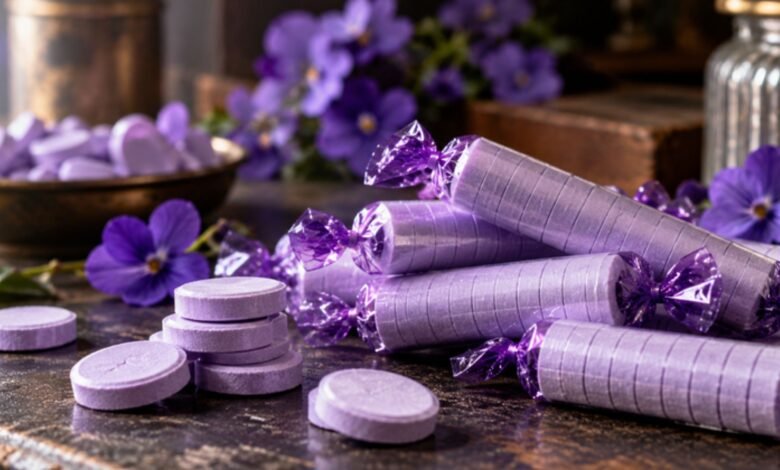
Parma Violets are easy to recognise and almost impossible to describe without starting a debate. The pale-purple sweets smell more like perfume than conventional candy, dissolve slowly on the tongue, and have inspired reactions ranging from affection to outright disbelief.
Yet in 2026, the Parma Violets story is not merely about childhood memories. The Swizzels brand has reached its 80th year, remains part of the manufacturer’s current range, appears in its vegan-sweets collection, and is still produced at a scale that surprises anyone who assumes this is a fading retro product. Swizzels says it makes around 100 million rolls of Parma Violets every year.
BLUF: Parma Violets are British hard tablet sweets made by Swizzels Matlow, launched in 1946 and named after the Parma violet flower. Their defining character is a sweet, intensely floral, perfume-like flavour, and they remain in production: Swizzels says it makes about 100 million rolls each year.
The 1946 launch that turned violet perfume into a sweet
The story begins with Swizzels’ Derbyshire roots rather than a modern confectionery trend.
Swizzels traces its present New Mills base to 1940, when the business moved north from London after the Blitz. The company took over a former textile mill in New Mills, High Peak, a site that had previously been associated with miners’ lamp wicks. During the Second World War, the factory was used to make water-purifying tablets for the Ministry of Defence before returning its attention to confectionery.
Then came 1946.
Swizzels’ official history records the launch of Parma Violets that year and adds a detail that changes how the product should be understood: they were originally marketed as breath fresheners and were frequently sold in pubs.
That makes the sweet less like a random floral experiment and more like a product designed around an older idea of confectionery as something aromatic, refreshing and social.
The timing is significant, too. In 2026, the 1946 launch date puts Parma Violets at 80 years old. Their age is therefore not an internet exaggeration or a loose piece of retro branding; it follows directly from the manufacturer’s own historical record.
Parma Violets at a glance
- Brand: Parma Violets
- Manufacturer: Swizzels Matlow
- Launch year: 1946
- Current age: 80 years in 2026
- Type: Hard, tablet-style confectionery
- Signature flavour: Violet; strongly floral and perfumed
- Colour: Purple/lilac
- Current manufacturer claim: About 100 million rolls made annually
- Vegan status: Listed by Swizzels within its vegan-sweets range
- National Parma Violets Day: 28 June, first observed by Swizzels in 2019
- Modern formats: Original rolls, Giant Parma Violets and larger party packs
What Parma Violets actually taste like — and why the word “soap” keeps coming back
The easiest way to misunderstand Parma Violets is to expect a conventional fruit flavour.
They do not taste like grape sweets, despite the purple colour. Their flavour is built around the sensory idea of violet itself: floral, sweet, aromatic and distinctly perfumed. Swizzels describes them as delicately perfumed and openly acknowledges that the flavour divides opinion.
That is why the “soapy” comparison persists.
Soap is not the defining ingredient in Parma Violets. “Soapy” is a description of the way some people interpret the aroma: intensely floral scents can cross into perfume, cosmetics and soap associations, particularly for people who are accustomed to fruit-forward sweets.
This is also why Parma Violets produce unusually strong reactions. A strawberry sweet gives the brain a familiar food reference. Violet asks the brain to process a flavour that also resembles fragrance.
One person tastes nostalgia.
Another tastes perfume.
Someone else tastes soap.
The sweet itself has not changed.
The purple appearance is part of the flavour expectation
The visual identity is unusually disciplined. The sweets are small purple tablets, and the colour prepares the eater for a floral experience before the first bite.
Swizzels says the product gets its name from the delicate purple flowers of the Parma violet plant. The confectionery therefore borrows both the plant’s name and its visual association, building a direct connection between colour, fragrance and taste.
The plant itself has a long association with fragrance and cultivation in Europe. The Royal Botanic Gardens Victoria describes Parma violets as a cultivated group of sweet-violet relatives associated historically with Italy and noted for their distinctive scent.
Are Parma Violets actually made from violets?
This is where the packaging imagery and the ingredient list diverge.
Swizzels’ ingredient and nutritional document lists the sweet as containing sugar, stearic acid, modified starch, glucose syrup, magnesium carbonate, flavourings and colour. Violet petals or violet extract do not appear in that published ingredient list.
That means the safest answer is:
Parma Violets are violet-flavoured sweets, but the published ingredient list does not identify violet flowers or violet extract as an ingredient.
The wording matters because recipes can change. Swizzels explicitly warns that products and ingredients can change and tells consumers to check the label on the product they are actually buying.
So the candy is named for the Parma violet and designed around its aromatic identity, while the published formulation uses a listed flavouring system rather than simply grinding violet petals into sugar.
The ingredient list tells another story
| Published characteristic | What the Swizzels documentation shows |
|---|---|
| Main base | Sugar |
| Texture-related ingredients | Modified starch, stearic acid |
| Syrup component | Glucose syrup |
| Anti-caking agent | Magnesium carbonate |
| Flavour | Listed as flavourings |
| Colour | Anthocyanin in the cited ingredient document |
| Violet flower/extract named | Not listed in that document |
| Energy | About 410 kcal per 100g in the cited document |
| Sugars | About 94g per 100g in the cited document |
The nutritional figures should be read alongside the date of the manufacturer document, not treated as a permanent guarantee. Swizzels’ current consumer guidance specifically warns that formulations may change.
The Indian aniseed story is often repeated — but the evidence needs a footnote
One of the most persistent claims about Parma Violets is that the sweets were based on aniseed confectionery traditionally consumed in India after spicy meals.
That explanation appears in secondary reference material, including the current Wikipedia entry for Parma Violets.
But there is an important editorial distinction: Swizzels’ own historical account confirms the 1946 launch, its original breath-freshener positioning and pub sales, but does not state that Indian aniseed confectionery was the inspiration.
That does not prove the aniseed story false. It means the provenance is not equally well documented.
For a reliable Parma Violets history, the 1946 launch is firmly established. The precise inspiration behind the recipe should be described more cautiously unless a primary source from Swizzels or contemporary archival material establishes it.
That distinction matters because food history is particularly vulnerable to stories that are repeated so often that repetition begins to look like evidence.
The secret of Parma Violets’ survival is not mass appeal
Swizzels itself acknowledges the controversy around the flavour. Its retro-sweet coverage effectively treats divisiveness as part of the product’s strength.
That is unusual.
Most confectionery is engineered for broad approval. Parma Violets operate differently. Their flavour is specific enough to create a recognisable audience, but unusual enough to remain memorable even among people who dislike them.
This makes the brand unusually durable.
A person may forget the exact taste of an ordinary boiled sweet. Parma Violets tend to create a much stronger memory because the flavour is so distinctive.
The result is a classic love-or-hate product with a built-in conversation mechanism.
You do not simply eat a Parma Violet.
You often explain whether you like Parma Violets.
That difference is commercially useful.
The numbers suggest the audience is larger than the stereotype
Swizzels says it produces roughly 100 million rolls of Parma Violets each year. That is a manufacturer-provided figure rather than an independently audited production statistic, but it remains useful evidence that the product is not surviving on nostalgia alone.
The current Swizzels shop also lists a 3kg Parma Violets Mega Party Pack described as containing approximately 400 individually wrapped rolls, while its current site continues to feature the product among its established brands.
The implication is hard to miss: Parma Violets have moved from pub breath freshener to mass-market retro sweet without losing their original identity.
Parma Violets are vegan — but the label still wins over memory
Swizzels currently lists Parma Violets among its vegan sweets. Its shop likewise describes the larger Parma Violets party pack as vegan-friendly.
That status fits the published ingredient profile, which does not list dairy, gelatine or other obvious animal-derived ingredients in the cited formulation. Still, consumers should use the physical packaging as the final authority because Swizzels specifically warns that ingredients can change.
The distinction is particularly useful for anyone buying older stock, imported products or third-party confectionery, where packaging and recipes may not match exactly.
The safe formulation is therefore Parma Violets are currently included in Swizzels’ vegan range, rather than an absolute claim that every Parma Violets product ever made has always had the same dietary status.
From purple tablets to Parma Violets cheese: the brand learned how far the flavour could travel
The strangest chapter in Parma Violets’ modern history arrived in 2016.
For the sweet’s 70th anniversary, Swizzels teamed up with The Cheshire Cheese Company to create Parma Violets cheese. Swizzels’ own company history records the experiment and says it generated substantial attention.
The collaboration made sense from a branding perspective. Parma Violets had already become more than a sweet; the flavour was recognisable enough to function as an independent identity.
That logic has since appeared in baking and dessert recipes too. Swizzels has published recipes using crushed Parma Violets in cheesecakes, brownies, cupcakes, ice cream-style desserts and other preparations. Its recipe material even includes vegan and gluten-free recipes featuring the sweets.
The important point is not that every Parma Violets experiment succeeded equally well.
It is that the flavour is now recognisable enough to be treated almost like a standalone culinary ingredient.
The timeline behind an eight-decade confectionery survivor
| Year | Parma Violets milestone | Why it matters |
|---|---|---|
| 1940 | Swizzels relocates to New Mills after the London Blitz | Establishes the Derbyshire manufacturing base associated with the brand |
| 1946 | Parma Violets launch | The product enters the market and is originally promoted as a breath freshener |
| 2016 | Parma Violets turn 70 | Swizzels launches a Parma Violets cheese collaboration |
| 2019 | First National Parma Violets Day | Swizzels records 28 June as the first official celebration |
| 2022 | Swizzels opens an additional factory in Middlewich | The company expands production capacity, although the site is associated specifically with Squashies rather than being identified as a Parma Violets factory |
| 2026 | 80 years since launch | The 1946 origin date makes Parma Violets an eight-decade-old confectionery brand |
National Parma Violets Day has its own date
The sweet’s place in British food culture is so established that it has its own celebration.
Swizzels records the first National Parma Violets Day on 28 June 2019, marked by a search for the biggest Parma Violets fan.
That date gives the product a useful annual moment online, but the more interesting point is what the celebration says about retro sweets in general.
Parma Violets are no longer sold merely as an old-fashioned sweet. They are marketed as an experience: a flavour associated with childhood, nostalgia, unusual taste and British confectionery history.
In other words, the story has become part of the product.
A small purple tablet became a recognisable British food reference
The strongest Parma Violets fact is not one ingredient, one celebrity endorsement or one advertising campaign.
It is recognisability.
The product can be identified from its colour, shape, wrapper, aroma and flavour before most people even read the name. That is a formidable advantage for a confectionery product launched in 1946.
The brand has also survived while its parent company modernised. Swizzels remains family-owned, still operates from New Mills, and says its sweets are now enjoyed in more than 20 countries, with a team of nearly 600 people.
Parma Violets therefore sit in an unusual position. They are old enough to be described as retro, but commercially active enough that “retro” does not mean discontinued.
That is why the sweet remains relevant in 2026.
People Also Ask: Parma Violets
What flavour are Parma Violets?
Parma Violets are violet-flavoured sweets with a sweet, floral and strongly perfumed taste. The flavour is deliberately aromatic rather than fruity, which explains why some people compare it with perfume or soap. Swizzels itself describes Parma Violets as delicately perfumed and notes that the flavour has a strongly divided audience.
Are Parma Violets made from real violets?
Parma Violets are named after the Parma violet flower, but the ingredient document published on Swizzels’ website lists flavourings rather than violet petals or violet extract. The safest interpretation is that the sweets reproduce the characteristic violet flavour through their flavouring system rather than simply using whole violet flowers. Formulations can change, so current packaging remains the final authority.
Are Parma Violets vegan?
Parma Violets are currently listed by Swizzels within its vegan-sweets range, and the manufacturer’s current 3kg party-pack listing describes the product as vegan-friendly. Consumers should still check the packaging they receive because Swizzels warns that ingredients and product formulations can change over time.
When were Parma Violets invented?
Parma Violets were launched in 1946 by Swizzels. The company’s historical record says they were initially marketed as breath fresheners and were frequently sold in pubs. That means 2026 marks 80 years since the confectionery first appeared commercially.
Why do Parma Violets taste like perfume or soap?
Parma Violets taste perfumed because their defining sensory character is strongly floral and aromatic. “Soapy” is a subjective description of that aroma rather than an indication that soap is used in the confectionery. People unfamiliar with edible floral flavours can find the profile especially similar to cosmetics or fragrance.
How many Parma Violets are made each year?
Swizzels says it makes approximately 100 million rolls of Parma Violets each year. This is a manufacturer-provided production figure rather than an independently audited industry statistic, but it demonstrates the commercial scale of the brand and helps explain why a confectionery launched in 1946 remains widely available.
Why this little purple sweet still matters in 2026
Parma Violets have survived because they never needed to become ordinary.
They remain recognisable precisely because the flavour is unusual, the colour is unmistakable and the history is unusually long. Swizzels launched them in 1946, first positioned them as breath fresheners, kept them alive through decades of changing confectionery tastes, and now presents them as part of a modern vegan range alongside newer sweets.
The 80th anniversary makes the timing especially revealing.
Parma Violets are old enough to be historical, but not so old that they belong only in a museum. They remain an active commercial product, a recognised British flavour, a social-media conversation starter and a nostalgic reference point for multiple generations.
The tiny purple tablet succeeded by doing something far harder than being universally liked.
It became impossible to confuse with anything else.
Sources & Verification
- Swizzels — Parma Violets official product page: current description, naming, annual production claim, National Parma Violets branding and product identity.
- Swizzels — Company History: 1940 relocation to New Mills, 1946 Parma Violets launch, original breath-freshener positioning and 2016 cheese collaboration.
- Swizzels — Our History: National Parma Violets Day on 28 June 2019 and later company milestones.
- Swizzels — Vegan Sweets: current inclusion of Parma Violets in the vegan range and ingredient-change warning.
- Swizzels — Official shop listing: current Parma Violets 3kg Mega Party Pack, vegan-friendly description and approximately 400 individually wrapped rolls.
- Swizzels — Ingredient & Nutritional Information PDF: published ingredient formulation and nutritional figures used in this article.
- Royal Botanic Gardens Victoria — Parma violet reference: botanical and fragrance context for the Parma violet plant.
- Wikipedia — Parma Violets: secondary reference consulted for the frequently repeated aniseed/India origin claim; this detail is explicitly treated here as less securely established than Swizzels’ own 1946 history.
Editorial Disclaimer: This article separates manufacturer-confirmed facts from secondary claims and interpretation. Production volumes, ingredients, product availability and dietary classifications can change, and current packaging should be checked for the latest formulation. The frequently repeated aniseed-and-India origin story is presented cautiously because it is not established in the manufacturer’s published history.
For More Visit Global Nova